

Trustworthy AI Starts With Trustworthy Information
AI can accelerate healthcare decisions, but trustworthy results begin with trustworthy information. Robin Ingalls-Fitzgerald explores data quality, clear definitions, governance, and human oversight in healthcare AI.
Beyond the Denial
Paid claims can hide reimbursement issues that denial reporting never captures. Learn why healthcare leaders should monitor reimbursement variance and treat paid claims as strategic financial intelligence.


The Revenue Leak AI Doesn't Want You to Notice
For years, healthcare organizations have measured revenue cycle performance by monitoring denials. But what if some of the greatest reimbursement risks never generate a denial at all?
As payers increasingly use AI and automated claim review technologies, claims may be paid, just not at the level they were originally billed. Because these claims don't enter traditional denial workflows, reimbursement reductions can continue for months before anyone recognizes a pattern.
In this month's feature article, Robin Ingalls-Fitzgerald explores how AI-driven payer reviews are changing revenue integrity, shares a real-world Emergency Department case where nearly $1,000 in reimbursement was almost lost, and outlines the questions every healthcare leader should be asking about paid claims, payer behavior, and reimbursement visibility.

What Aging Receivables May Be Warning You About
Most healthcare organizations track aging receivables, but fewer recognize what those trends may be revealing. Growing aging balances often signal operational challenges developing much earlier in the revenue cycle, from authorization delays and payer slowdowns to coding issues and unresolved denials. Learn why aging receivables are more than a financial metric and what they may be warning you about.

The CPT® 2027 Maternity Care Restructure: Why Revenue Cycle Leaders Should Be Paying Attention
The biggest OB coding change in decades is coming January 1, 2027.
The shift away from the traditional global maternity package isn't simply a coding update. It's a fundamental change that will impact documentation, charge capture, labor management reporting, reimbursement workflows, and revenue cycle operations.
Organizations that begin preparing now will be better positioned to navigate the transition, reduce operational disruption, and strengthen revenue integrity before implementation begins.
Read our latest analysis on what healthcare leaders should be watching and how to prepare.

The Hidden Cost of Siloed Revenue Cycle Data
Revenue cycle data doesn’t live in one place, and when it stays disconnected, so do the insights.
Billing sees one piece.
Audit sees another.
Finance sees the result.
The challenge isn’t a lack of data. It’s a lack of connection.
When those pieces aren’t aligned, trends are missed, issues repeat, and revenue is impacted before anyone sees it clearly.
This article breaks down the hidden cost of siloed data and why more organizations are shifting toward a more connected view.
👉 Read more:

Why Denial Rates Alone Don’t Tell the Full Story
Denial rates are one of the most tracked metrics in revenue cycle, but they only tell part of the story.
A denial shows that something went wrong. It doesn’t show when it started, how often it’s happening, or what the broader financial impact looks like.
Focusing only on denial rates can create a false sense of visibility, where issues appear managed but underlying patterns continue.
This article explores why looking beyond denials leads to a clearer understanding of revenue performance.

Payer Behavior Is Shifting Faster Than Most Teams Can Track
Across multiple organizations, we’re seeing:
Increased use of medical necessity denials
More frequent payment reversals
Greater variance between expected vs actual reimbursement
This is where traditional reporting falls short.
By the time these trends are visible in AR reports, the revenue impact has already occurred.

The Shift in Payer Behavior Revenue Cycle Leaders Should Be Watching
Denials aren’t just increasing. They’re evolving.
What used to be isolated claim issues are now often signals of broader payer behavior shifts. And by the time those patterns show up in reports, the financial impact is already in motion.
The advantage today isn’t in reacting faster.
It’s in recognizing the pattern earlier.

What Revenue Leaders Miss When Data Lives in Silos
Revenue cycle teams generate more data than ever before.
But more data doesn’t always mean more clarity.
When insights from coding, billing, payer behavior, and financial performance remain disconnected, critical patterns stay hidden until revenue is already impacted.
The risk isn’t a lack of information.
It’s the inability to see how it all connects.

CMS Scrutiny Is Evolving. Revenue Leaders Need to Evolve With It.
Revenue disruption rarely starts in billing. As CMS and payers rely more heavily on pattern-based review, documentation and coding alignment are directly influencing financial performance.
This article explores why compliance insight and revenue visibility can no longer operate in silos.

CMS Telehealth 2026 Update: The Calm Before 2028
CMS has extended most Medicare telehealth flexibilities through December 31, 2027 — but 2028 introduces meaningful structural changes. From practitioner eligibility to hospital remote billing and behavioral health requirements, revenue and compliance leaders should be planning now. Here’s what stays, what sunsets, and where your organization may be exposed.
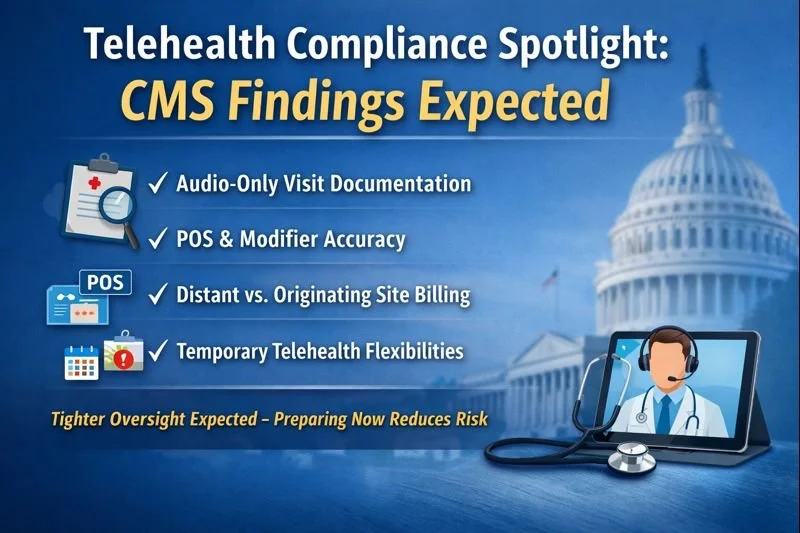
Telehealth in 2026: What Providers Should Review Before CMS Releases Findings
CMS telehealth findings are expected later this month, and scrutiny is increasing.
While Medicare telehealth flexibilities remain in effect through January 30, 2026, CMS is taking a closer look at how services are documented, billed, and audited, particularly for audio-only visits and rural providers.
Now is the time to review telehealth utilization, audit documentation, and understand revenue tied to temporary flexibilities.
Preparation now creates options later.


Why Denials Are Increasing and How Hospitals Can Get Ahead of 2026 Trends
Claim denials are rising across hospitals and provider organizations, driven by expanding prior authorization requirements, stricter medical necessity standards, and evolving CMS and payer policies. As 2026 approaches, denial prevention is becoming a critical component of financial stability. Organizations that strengthen documentation, improve workflow alignment, and monitor payer behavior proactively will be better positioned to protect revenue.
What Hospitals Should Expect from CMS Audits in 2026
CMS is expanding its audit and program integrity efforts in 2026, and hospitals should expect increased scrutiny across outpatient services, price transparency, and documentation accuracy. These audits go beyond the OPPS and ASC Final Rule and reflect CMS’s broader focus on data integrity, billing alignment, and financial stewardship. Understanding where CMS is concentrating its attention now allows organizations to reduce audit risk and protect reimbursement.

Hospital Price Transparency Enforcement: What Providers Need to Know for 2026
CMS is raising the bar on hospital price transparency, and the 2026 OPPS and ASC Final Rule makes it clear that compliance is no longer just about posting files. Hospitals must now deliver complete, consumer-ready pricing that patients can understand and CMS can validate. As enforcement increases, revenue integrity, billing, and compliance teams will need stronger internal alignment to avoid penalties and protect trust.
CMS 2026 Physician Fee Schedule Final Rule: Key Implications for Billing
Excerpt for Blog
The CY 2026 Physician Fee Schedule brings some of the most significant shifts billing teams have seen in years.

The Most Frequent Coding Errors and How to Avoid Them
Share insights on the most frequent coding errors and how to avoid them.